Boundary Ride #10: Erith to Rainham Gravel Route London

Soap factories, salt marshes and a free Uber across the Dartford Crossing.
A 37 km ride from Erith to Rainham through one of the most unexpectedly compelling stretches of the London boundary. Industrial, flat, occasionally bizarre, and genuinely surprising from start to finish. Most cyclists would cross this off the list without looking at it. That would be a mistake.
The route follows the River Cray through salt marsh and mudflat, crosses the Dartford Crossing in a National Highways maintenance van, passes a Norman church sitting in the middle of a soap factory, and finishes through Rainham Marshes — the largest wetland on the upper Thames Estuary, which nearly became a Universal theme park. Boundary Ride 10 completes the circuit. It does so in considerable style.
Ride Details
Ride Level: Easy (Green)
Distance: 37 km / 23 miles
Ascent: 167 m / 548 ft
Off-road: 65%
Terrain: Creek and salt marsh trail, flood levee path, light gravel, quiet industrial roads, Thames Path
Bike: Gravel, cyclocross, hybrid or e-bike
Start: Erith Station (Zone 6, Southeastern)
Finish: Rainham Station (Zone 6, c2c)
Includes: GPX route file and downloadable ride guide
The Route
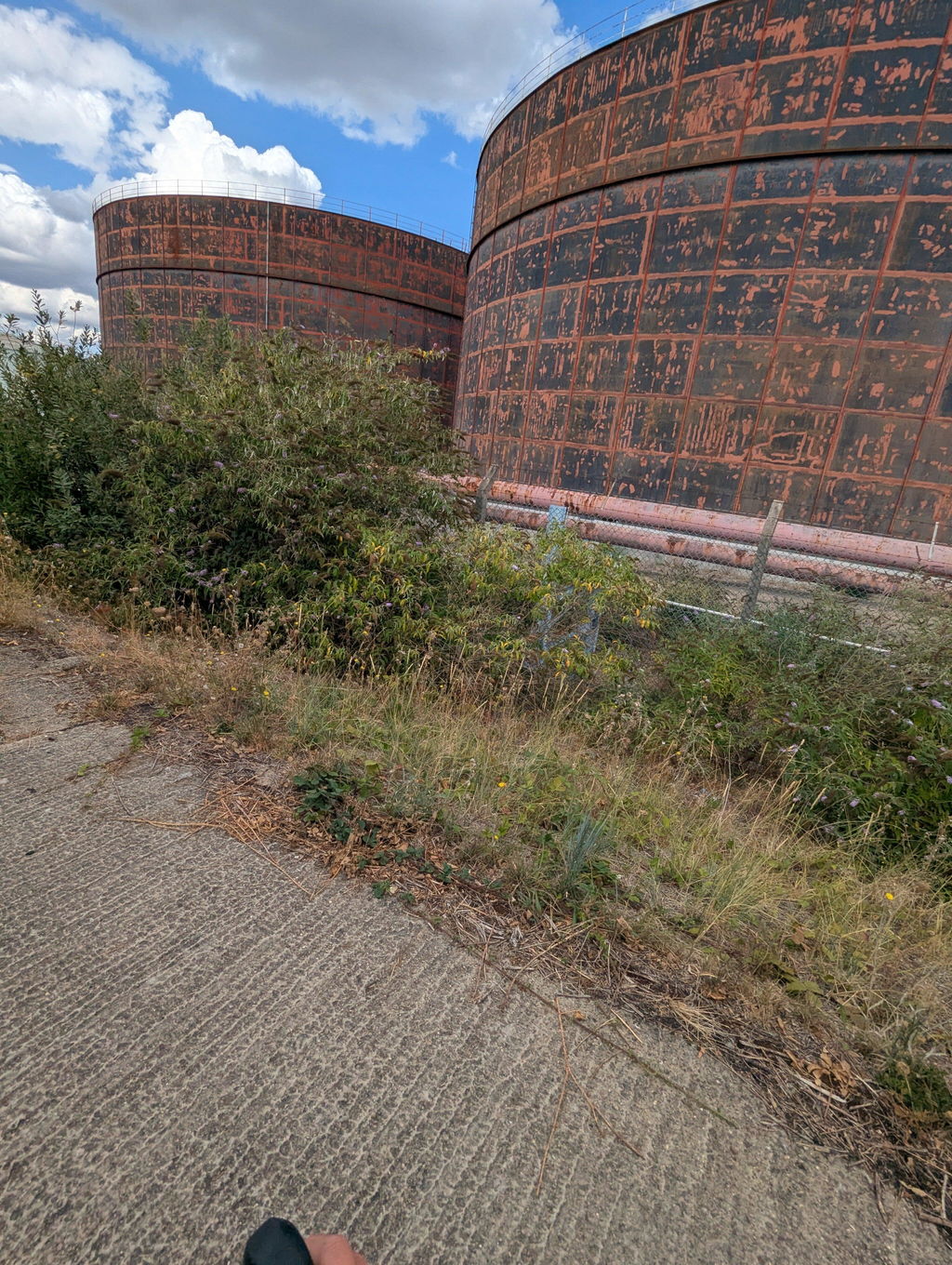
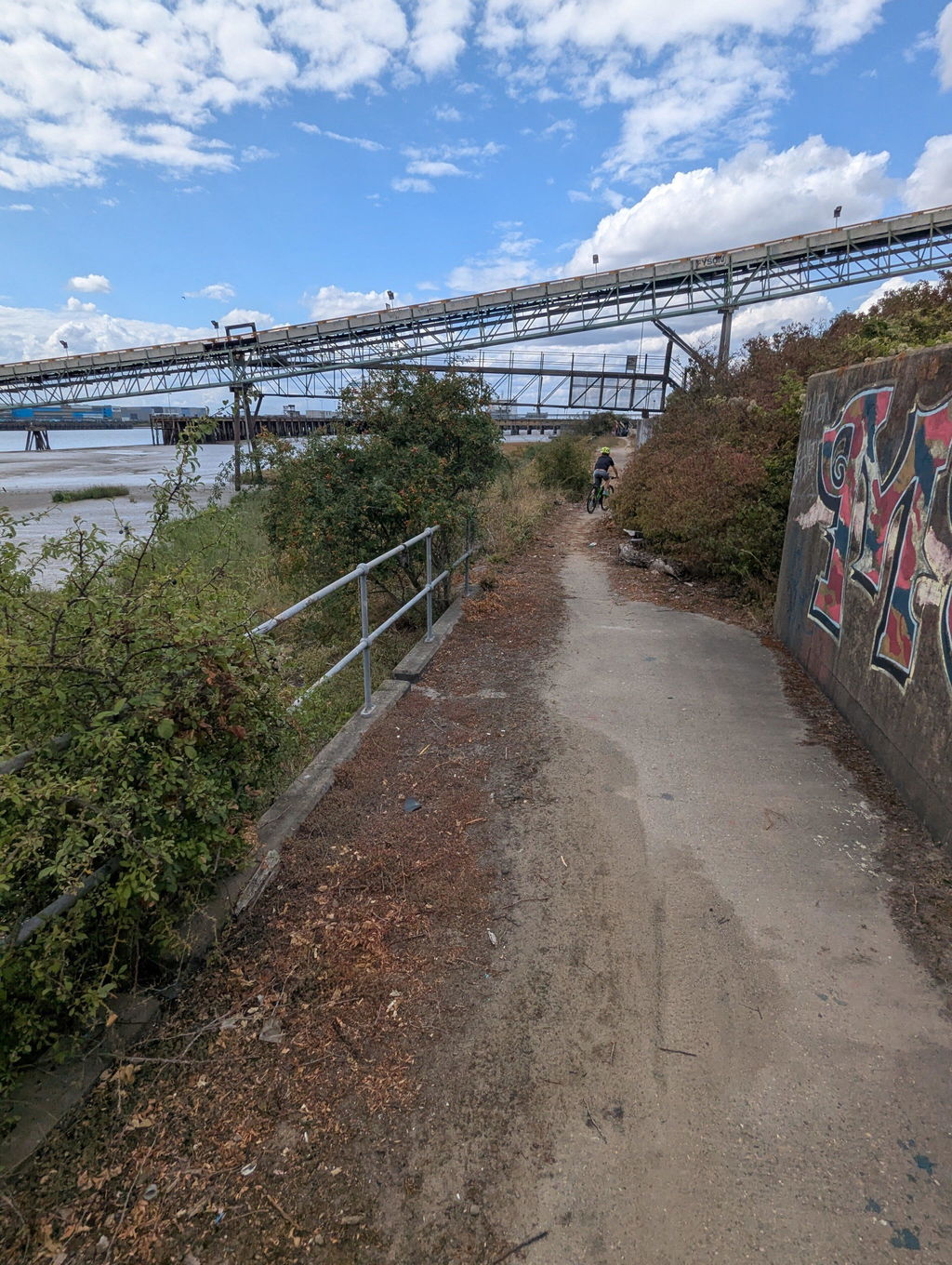
The ride starts at Erith, where the Thames is wide and brown and entirely unbothered by its own reputation. The route picks up the River Cray heading east, following the flood levee alongside the creek. The path sits on top of the bank, and the contrast is immediate. On one side: salt marsh, mud glistening at low tide, reeds, birds. On the other: haulage yards, distribution centres, lorries. Two landscapes a metre apart, and the path running between them for long enough that you stop finding it strange.
At Dumbarton Wharf, the Thames sailing barge Decima sits with her tanbark sails furled, green hull bright against the creek. She has no obvious business being beautiful in a place like this. She is.
Then Dartford — very specifically North Kent, and North Kent is its own thing. Not commuter belt. Not Home Counties. St George's flags, medieval timber frames, and a pub called the Wat Tyler, named for the man who led the Peasants' Revolt of 1381. Tyler and his followers drank here before marching on London.
The Dartford Crossing comes next, and with it one of the great English institutional arrangements. Cyclists do not cross the bridge. They wait in a bus shelter until someone notices them. A National Highways maintenance van takes them across in the cab. The workers do this with complete professionalism. The system has clearly never been reviewed by anyone who has tried it. Think of it as a free mid-route Uber.
St Clement's Church, West Thurrock
Turn left at the Procter and Gamble sign and you find it. St Clement's Church, West Thurrock. Pre-conquest foundations. Knapped flint. Grade I listed. Sitting in the middle of a soap factory like it owns the place, which in a sense it does.
Procter and Gamble built their plant next door in 1940. The church survived the century badly — roof stripped, interior gutted, vandalised. By the 1980s it was falling apart. In 1987 the company offered to take responsibility. Three years later the restoration was complete. A Norman church saved by a detergent manufacturer. It was also the church used for the funeral scene in Four Weddings and a Funeral. You stop. You look at it. Then you get back on the bike.
The Finish
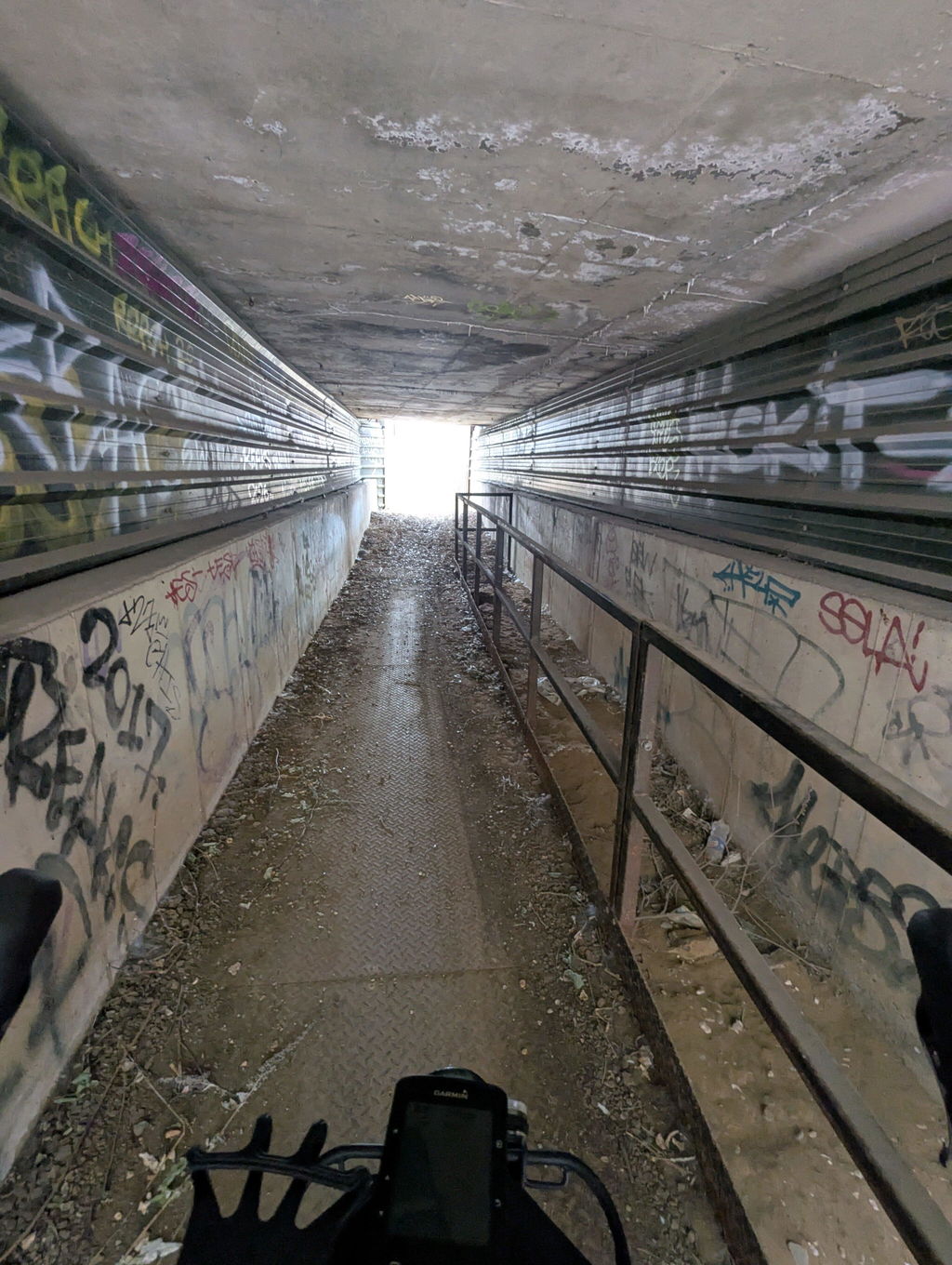
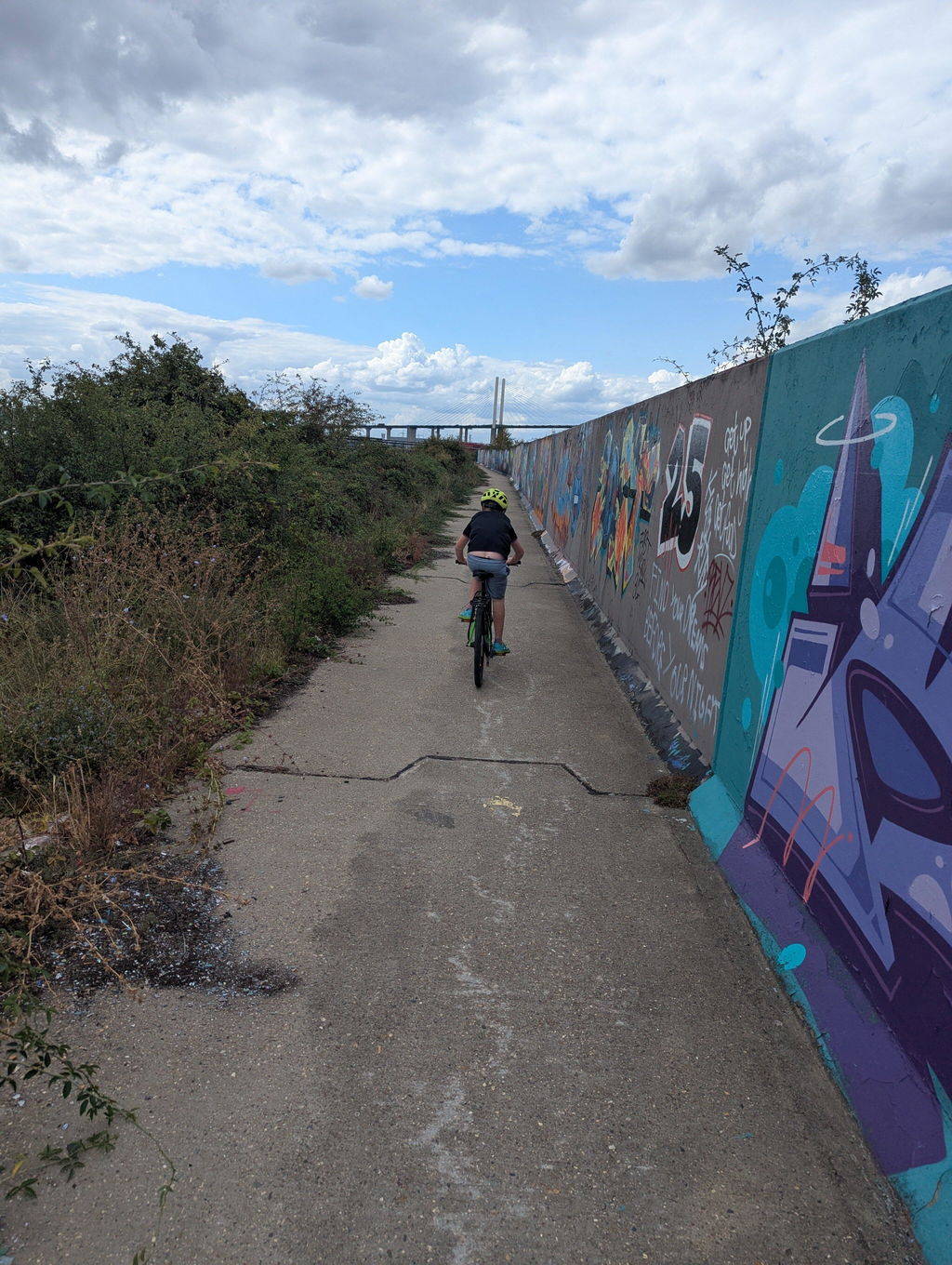
The Thames Path beyond the factory gates is unexpectedly good. A WW1 biplane bursts through a crumbling brick wall on the flood defence — painted, full-colour, RAF roundel intact. Further along, bold abstract graffiti runs the length of the levee. It is a working gallery. Ride slowly.
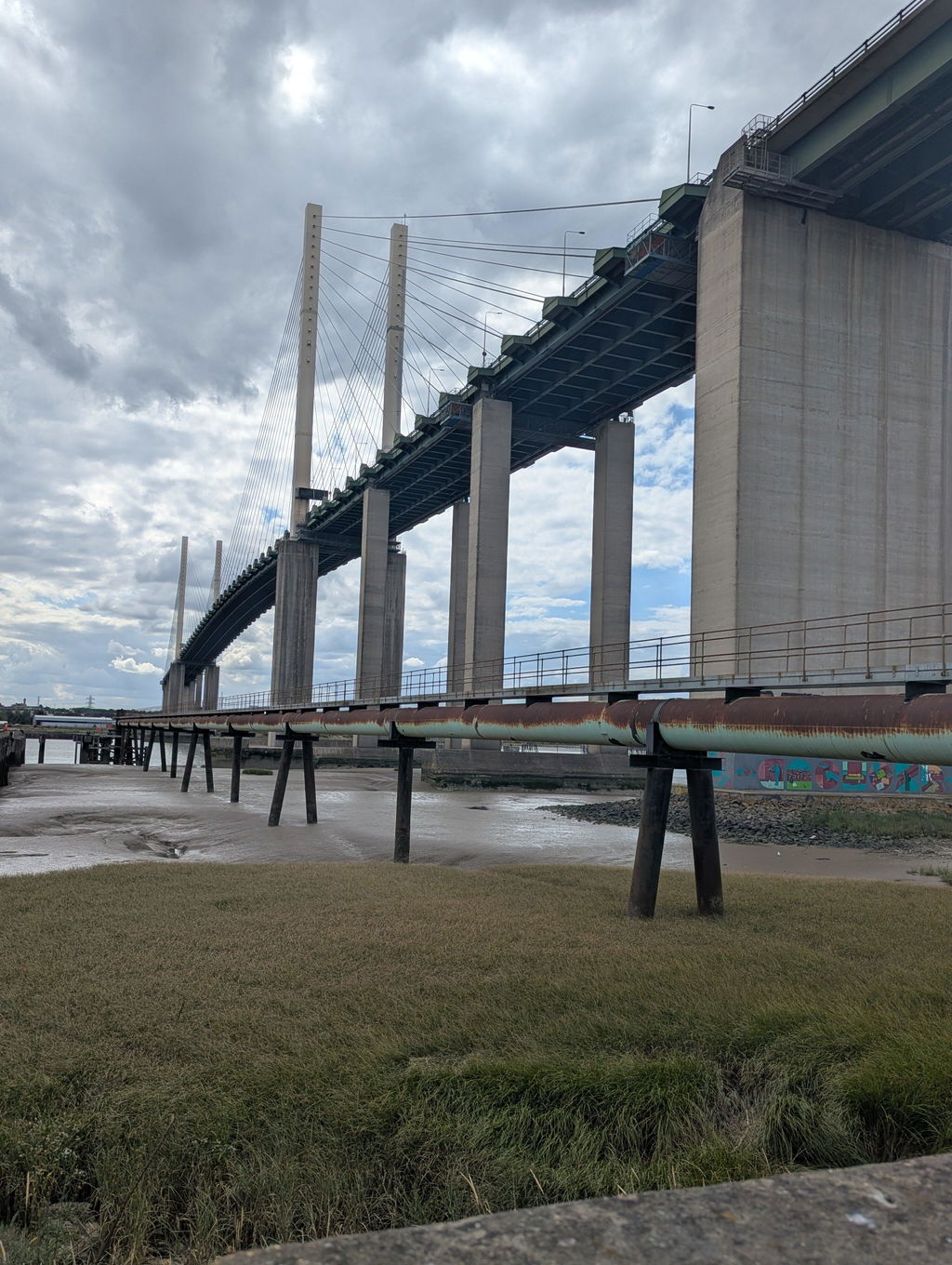
WW2 pillboxes sit in the grass at the water's edge, still watching the river. The QE2 Bridge appears, and from directly underneath the scale of it is something else entirely. Trucks overhead. The river wide on either side.
Purfleet's Royal Gunpowder Magazine appears next — the one where Benjamin Franklin advised on lightning protection, the drainpipes turned out to be doing the actual work, and the president of the Royal Society resigned in protest. Turner sketched it between 1805 and 1808. The drawings are in the Tate.
A row of saluting soldier silhouettes lines the levee beside the Gurkha War Memorial. Sixteen concrete barges sit in the Thames mud at Coldharbour Point, placed there as flood defences in 1953. Then Rainham Marshes — reed beds, lapwings, one of the densest water vole populations in the country. The kind of quiet that accumulates in a place that has been left alone long enough.
Rainham station is ten minutes beyond the far edge. The ride — and the circuit — is done.
What's Included
✦ GPX file for your GPS device or phone
✦ Downloadable ride guide with route notes and highlights
✦ Access to the full Boundary Rides collection
About the Boundary Rides
Ten railway-to-railway rides that together circle the capital through its overlooked, underappreciated and frequently surprising edges. Boundary Ride 10 is the final piece of the circuit. Each ride is designed for a gravel or hybrid bike, starts and finishes at a London station, and takes in a stretch of the boundary most cyclists never think to explore.
The Boundary Rides Collection
 Ride 1
Boundary Ride 1
Boundary Ride #1. Rainham to Harold Wood.
 Ride 2
Boundary Ride 2
Boundary Ride #2. Harold Wood to Enfield Lock.
 Ride 3
Boundary Ride 3
Boundary Ride #3. Enfield Lock to Mill Hill Broadway
 Ride 4
Boundary Ride 4
Boundary Ride #4. Mill Hill Broadway to West Ruislip
 Ride 5
Boundary Ride 5
Boundary Ride #5: West Ruislip to Feltham Gravel Route London | Coming Soon
 Ride 6
Boundary Ride 6
Boundary Ride #6 Feltham to Cheam Gravel Ride via Hampton Court & Nonsuch Park
 Ride 7
Boundary Ride 7
Boundary Ride #7 Cheam to Whyteleafe, Lavender Fields and Battle of Britain Trails
 Ride 8
Boundary Ride 8
Boundary Ride #8 Whyteleafe to Knockholt
 Ride 9
Boundary Ride 9
Boundary Ride #9: Knockholt to Erith
 This ride
Boundary Ride 10
Boundary Ride #10: Erith to Rainham Gravel Route London
This was just adventure from start to finish, it was a complete blend of industrial brutality and stunning landscape of the river thames with wildlife striving all around you.
I did it with my 8 year old and we did it in day. Going across the dartford crossing has always been on my todo list but I've never known how to get across! After the fee roundabouts in purfleet after the bridge the North of the river was epic gravel riding with superb scenery especially as you pass under the iconic crossing.
The only thing this route lacks is the cafe or coffee shop (or we couldn't find one),!we would have appreciated it even rainham marshes had no tea bar at time!